
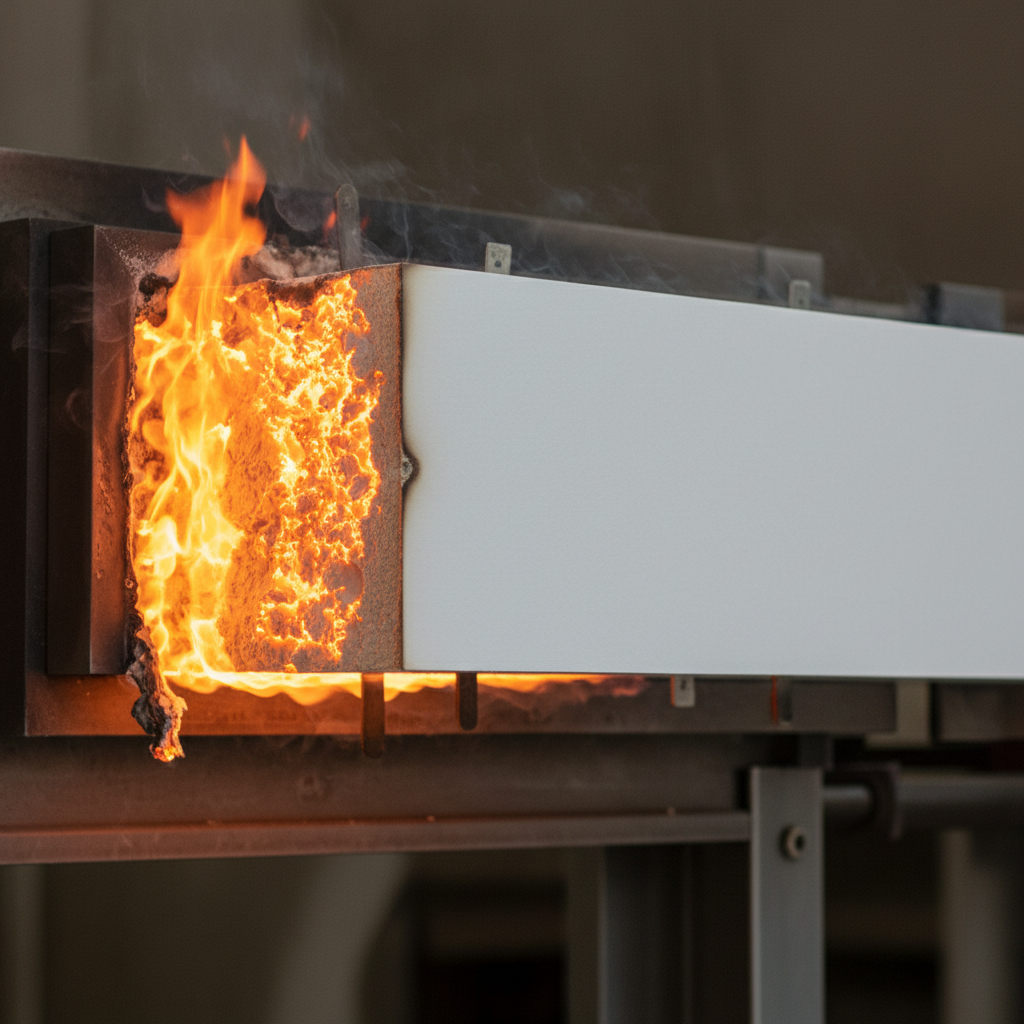
How Many Hours Does Your Assembly Actually Hold?
Every board we manufacture is rated in hours — the same hours your occupancy type demands under ASTM E119 and UL 263 — the tabs already open in your other browser window.
Not marketing language. Not approximations. Tested assemblies with UL listing numbers your AHJ will accept on first review.
Four Phases. One Compliant Assembly.
Click any card to reveal the code reference behind it. Work through all four phases and you'll have everything needed for a complete submittal package.
Identify Required Rating
Occupancy Classification
IBC Table 601 maps your occupancy type — A, B, E, F, H, I, M, R, S, U — to the minimum fire-resistance rating for load-bearing and non-load-bearing walls.
IBC Table 601 Reference
Group I-2 (hospitals) requires 2-hour bearing walls. Group B (offices) typically 1-hour in Type III-A construction. Verify with AHJ for mixed-occupancy separations.
Separation Distance
Exterior wall fire-resistance ratings depend on separation distance from the property line. Under 5 feet demands the highest rating; over 30 feet may require none.
IBC Table 602
At 3-ft separation, non-load-bearing exterior walls require 1-hour rating minimum. At <3 ft, 2-hour minimum applies for most Type III construction.
Corridor Requirements
NFPA 101 §19.3.6 and IBC §1020 govern corridor fire ratings. Sprinklered buildings often drop from 1-hour to 0-hour — but verify before spec.
NFPA 101 §19.3.6
Fully sprinklered Group I-2 corridors: 0-hour if sprinklers are NFPA 13 compliant. Non-sprinklered: 1-hour minimum. Document your basis of design.
Shaft & Vertical Penetrations
Elevator shafts, stair enclosures, and mechanical chases have their own rating requirements — often 2-hour regardless of building type.
IBC §713 Shaft Enclosures
4 or more stories: 2-hour shaft enclosure required. 3 or fewer: 1-hour. Exception for fully sprinklered buildings connecting ≤3 floors.
Select Board Composition
Type X — Standard Fire
The baseline specification. 5/8" Type X contains glass fiber and vermiculite to slow calcination. Achieves 1-hour with single-layer, 2-hour with double-layer on steel studs.
ASTM C1396 Type X
Core: expanded vermiculite + glass fiber reinforcement. Min. 5/8" thickness. 1-hr: 1 layer each side. 2-hr: 2 layers each side. UL U419 base assembly.
Type C — Enhanced Core
Type C uses a higher glass fiber content and shrinkage-compensating additives. It maintains structural integrity at temperatures where Type X begins to crack.
ASTM C1396 Type C
Achieves 1-hour with 1/2" single layer — saving 1/8" per side. Critical in retrofit corridors where existing framing limits total assembly depth.
Glass Mat — Moisture + Fire
Glass mat gypsum board (ASTM C1177) replaces paper facing with fiberglass mesh. Rated for wet areas — mechanical rooms, exterior soffits, and humid corridors.
ASTM C1177 / C1178
Use where moisture and fire ratings overlap: commercial kitchens, pool enclosures, exterior applications. Verify UL assembly number includes glass mat product.
Abuse-Resistant — High Traffic
AR board has a hardened core and reinforced facing. Specified in corridors, stairwells, and public spaces subject to impact. Maintains fire rating while resisting surface damage.
ASTM C1629 Level 3
Level 3 (highest): resists hard body impact ≥150 ft-lbs. Available in Type X and Type C compositions. Verify specific UL assembly for AR product inclusion.
UL Assembly Numbers
Reading a UL Number
UL assembly designations encode the construction type. "U" prefix = non-load-bearing partition. "W" = load-bearing wall. "L" = floor-ceiling. The number is your legal spec reference.
UL Assembly Anatomy
Example: UL U419 → U (partition) + 419 (sequence). Always cite the full UL number on shop drawings. AHJs and inspectors will verify against UL's online directory.
Stud Gauge & Spacing
UL assemblies specify minimum stud gauge and maximum spacing. Substituting 25-gauge for 20-gauge or widening to 24" OC without an alternate assembly voids the listing.
Critical Variables
1-hr steel: 25 ga min, 24" OC max. 2-hr steel: 20 ga min, 24" OC max. Wood stud assemblies: typically 2x4 at 16" OC. Document in submittal package.
Screw Pattern Compliance
Screw spacing is a listed variable. Type S screws at 12" OC field / 8" OC edges for 1-layer Type X. Double-layer assemblies add a base-layer screw pattern.
Fastener Requirements
Base layer: 1-5/8" Type S, 24" OC vertical. Face layer: 1-7/8" Type S, 12" OC vertical, offset from base. Screw length must penetrate stud flange by minimum 3/8".
Layer Count & Offset
Multi-layer assemblies require horizontal joints of adjacent layers to be offset by at least 24". Vertical joints must be offset by one stud bay minimum.
Joint Offset Rules
Failure to offset joints is the #1 inspection rejection on 2-hr assemblies. Mark offset requirements on shop drawings. Verify with foreman before installation begins.
Inspection & Compliance
Joint Offset Failures
The most common inspection failure: butt joints aligned across layers. Inspector will require remediation — which means cutting out and rehanging board after framing is buried.
Prevention Protocol
Require superintendent sign-off at base layer before face layer begins. Photograph joint locations. Include joint offset diagram in pre-install meeting package.
Penetration Sealing
Every pipe, conduit, duct, and cable penetrating a fire-rated assembly requires a listed firestop system. An unsealed penetration nullifies the hourly rating of the entire wall.
ASTM E814 / UL 1479
System selection depends on annular space, substrate, and penetrant type. Document each penetration with a UL-listed firestop system number on the penetration schedule.
Head-of-Wall Condition
The top track deflection gap must be sealed with an approved head-of-wall firestop product. Standard caulk is not a listed system. This is a code requirement, not a detail.
UL HW System
Use a UL-listed head-of-wall system rated for the assembly's required rating. Maximum deflection gap per listing: typically 1/2" to 2". Verify with structural engineer.
Submittal Documentation
A complete submittal includes: UL assembly number, product data sheets, ASTM test reports, and a marked-up reflected ceiling plan showing rated assembly locations.
Submittal Checklist
□ UL assembly number cited □ Product data sheet (current) □ ASTM test report reference □ Penetration schedule □ Head-of-wall detail □ AHJ pre-approval if alternate assembly
Find Your Fire Rating
Five questions. One matched assembly. Download the exact spec sheet your submittal package needs.
What is your occupancy type?
↗ IBC Table 601 — determines minimum fire-resistance rating
Answer questions to build your assembly
Harborview Medical Center
340,000 sf tenant improvement, Group I-2 occupancy
Zero inspection rejections. AHJ approved submittals first review.
Marcus Delgado, PE — Fire Protection Engineer
Meridian Commerce Park
12-building industrial campus, Group S-1 separations
Delivered 47 UL assembly packages across 12 buildings in 3 weeks.
Priya Nair — Project Manager, Thornton Construction
The Alderton — Mixed Use
Group R-2 over Group B, 18-story tower, occupancy separation
STC 52 achieved simultaneously with 2-hr fire rating. One submittal.
James Okafor — GC Superintendent, Westfield Build
Already holding drawings?
Skip the quiz. Call a fire-rating specialist now and get a UL assembly number in 15 minutes.